

The 2026 Reality: Compliance Is Now Operational, Not Occasional
Most CRA problems don’t start with aggressive tax strategies—they start with missed details.
A notice not seen. A payroll remittance sent late. A GST/HST claim without proper support.
In 2026, the biggest shift is not a new tax rule—it’s how the CRA communicates. With online mail now the default, businesses that are not actively monitoring their accounts can miss deadlines without realizing it.
The implication is simple: compliance is no longer periodic—it’s continuous.
Why CRA Online Mail Is the Biggest 2026 Risk
For many businesses, the most immediate risk is not tax rates—it’s missed communication.
Most CRA correspondence is now delivered through My Business Account, and it is considered received when posted.
Why this matters:
- No paper letter may arrive
- Deadlines start immediately after posting
- Missed notices can lead to penalties or reassessments
What to do now:
- Assign a responsible person to check CRA accounts regularly
- Ensure email notifications are enabled and up to date
- Integrate CRA checks into weekly or monthly workflows
Operational insight: Treat CRA correspondence like a bank account—something that must be monitored, not checked occasionally.
Key CRA Deadlines Small Businesses Must Track
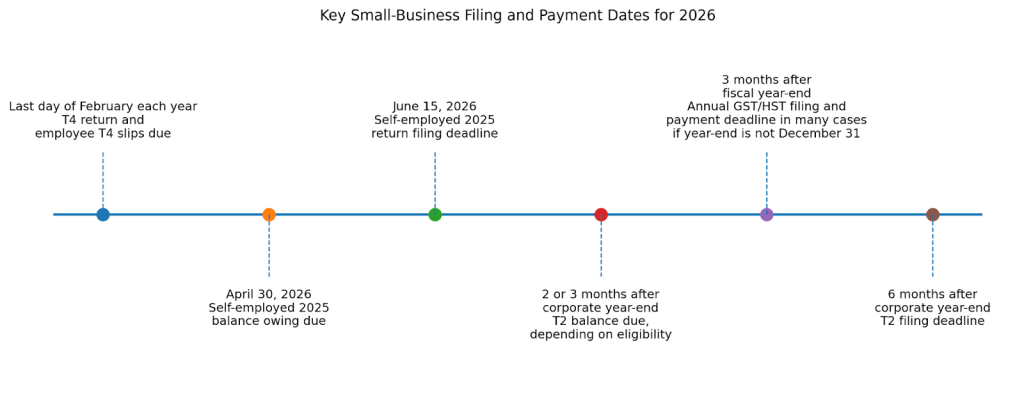
Deadlines vary based on your business structure—but missing them creates immediate financial exposure.
Sole Proprietors
- Filing deadline: June 15, 2026
- Payment deadline: April 30, 2026
Corporations
- T2 filing: Within 6 months of year-end
- Balance due: Typically 2–3 months after year-end
Employers
- Payroll remittances: Based on assigned schedule
- T4 slips: Due end of February
GST/HST Filers
- Deadlines depend on reporting period and year-end
Critical risk: Filing and payment deadlines are often different—and confusing them is a common mistake.
Payroll: The Fastest Way to Trigger CRA Penalties
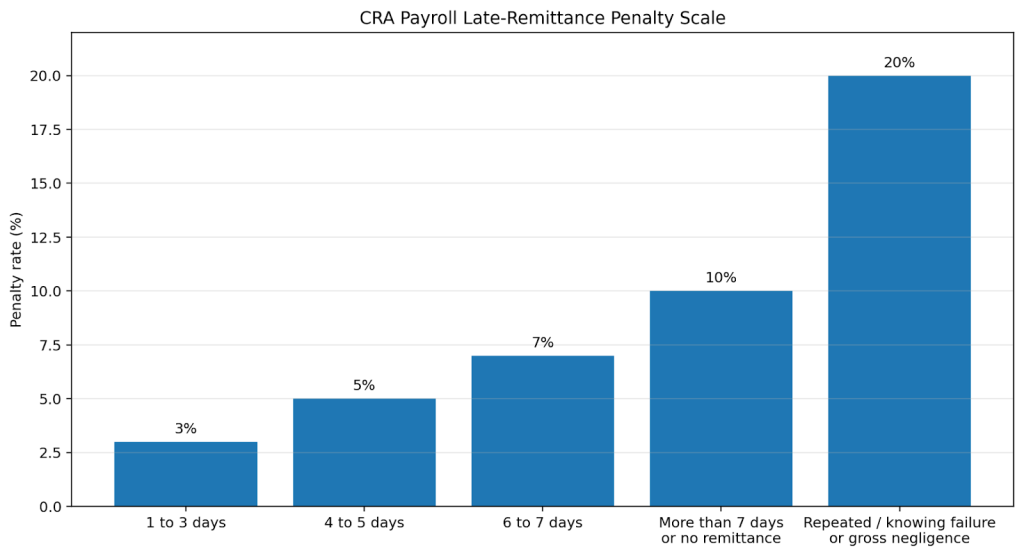
Payroll errors escalate quickly because remittances are frequent and tightly enforced.
Common payroll risks:
- Late source deductions (CPP, EI, income tax)
- Incorrect remittance amounts
- Missed T4 filing deadlines
Why payroll matters:
- Funds withheld are not business funds
- Penalties increase based on delay duration
- Repeat issues can trigger higher penalties
Ontario-specific consideration:
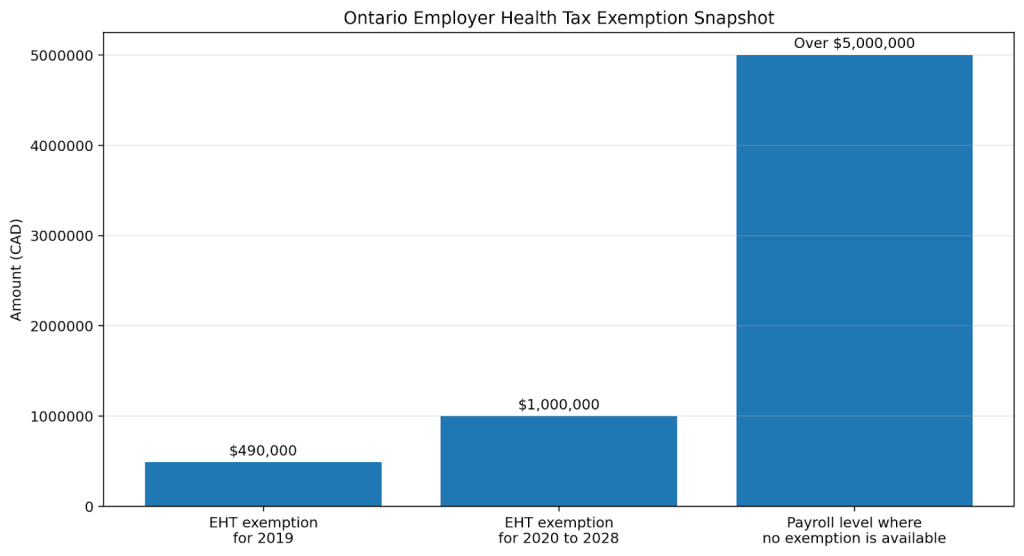
- Employer Health Tax (EHT) applies beyond certain payroll thresholds
- Exemption rules must be monitored carefully
Key takeaway: Payroll is one of the highest-risk areas for small businesses—and requires strict discipline.
GST/HST: Where Documentation Drives Risk
GST/HST compliance is less about calculation and more about documentation quality.
What to watch:
- Registration thresholds (e.g., small supplier rules)
- Filing deadlines by reporting period
- Input Tax Credit (ITC) support
ITC risk factors:
- Missing or incomplete invoices
- Incorrect supplier information
- Poor record retention
Insight: Many businesses pay GST/HST correctly—but fail to support claims properly, creating audit exposure.
What CRA Review Risk Looks Like in Practice
There is no public checklist of audit triggers—but patterns are consistent.
Common risk signals:
- Late filings or repeated delays
- Inconsistent records vs filings
- Unsupported expenses or ITCs
- Payroll discrepancies
Recordkeeping requirements:
- Maintain supporting documents for income and expenses
- Keep GST/HST and payroll records
- Retain records for at least six years
Penalty exposure:
- Late corporate filings can trigger escalating penalties
- Repeated issues increase scrutiny and cost
Strategic insight: CRA risk increases when your records and filings tell different stories.
How Business Structure Changes Your CRA Exposure
Different structures create different compliance obligations.
| Business Type | Key Obligation | Primary Risk |
| Sole Proprietor | Personal tax filing | Weak expense support |
| Corporation | T2 filing & payments | Late filing, missed notices |
| Employer | Payroll remittances | Late deductions |
| GST/HST Registrant | Indirect tax compliance | Unsupported ITCs |
Insight: Many businesses focus on income tax—but payroll and GST/HST often create greater risk.
Practical Roadmap: Staying CRA-Compliant in 2026
Strong compliance comes from consistent systems—not last-minute fixes.
Step-by-step approach:
- Confirm all CRA accounts (corporate, payroll, GST/HST)
- Assign responsibility for CRA online mail monitoring
- Build a compliance calendar with all deadlines
- Reconcile books monthly
- Review invoice quality and documentation
- Align records with filed returns
Operational takeaway: Most CRA issues are preventable with structure and consistency.
Common Mistakes That Create CRA Problems
- Ignoring CRA online mail
- Missing payment deadlines while filing on time
- Treating payroll as flexible
- Claiming ITCs without proper documentation
- Overlooking Ontario Employer Health Tax
- Keeping incomplete or inconsistent records
Pattern: Small operational gaps—not complex tax issues—cause most CRA problems.
FAQs
Does CRA still send paper mail?
Most business correspondence is now delivered online through My Business Account.
What is the most common deadline mistake?
Confusing filing deadlines with payment deadlines—especially for self-employed individuals.
How late can a corporation file?
Late filings trigger penalties that increase over time.
When are T4 slips due?
By the end of February following the calendar year.
What records must businesses keep?
Records supporting income, expenses, GST/HST, and payroll—typically for six years.
Can GST/HST claims be made without full documentation?
That is risky. Proper invoices and supporting documents are required.
Does Ontario EHT apply to small businesses?
Yes, depending on payroll size and eligibility thresholds.
Final Takeaway
In 2026, CRA compliance is less about understanding tax rules and more about managing processes effectively.
Businesses that:
- Monitor CRA online mail
- Track deadlines accurately
- Maintain clean records
- Align filings with documentation
are far less likely to face penalties or reviews.
Speak With an Advisor
If your business is unsure about CRA deadlines, payroll setup, GST/HST compliance, or recordkeeping, a structured review can reduce risk significantly.
A Clearwealth advisor can help you:
- Build a compliance calendar
- Strengthen documentation systems
- Review CRA notices and filings
Request a tailored compliance review to stay ahead of CRA requirements.
Disclaimer
This article is general information only, not legal or tax advice. CRA and Ontario Ministry of Finance rules can change, and the right answer depends on your business situation.
Sources and References
- https://www.canada.ca/en/revenue-agency/services/e-services/digital-services-businesses/business-account/about-business-account/online-mail-for-business.html
- https://www.canada.ca/en/revenue-agency/news/newsroom/tax-tips/tax-tips-2025/businesses-ready-for-cra-mail-to-go-online.html
- https://www.canada.ca/en/revenue-agency/services/tax/individuals/topics/important-dates-individuals.html
- https://www.canada.ca/en/revenue-agency/services/tax/individuals/topics/important-dates-individuals/filing-dates-tax-return.html
- https://www.canada.ca/en/revenue-agency/services/tax/businesses/topics/corporations/corporation-income-tax-return/when-file-your-corporation-income-tax-return.html
- https://www.canada.ca/en/revenue-agency/services/forms-publications/publications/t4012/t2-corporation-income-tax-guide-before-you-start.html
- https://www.canada.ca/en/revenue-agency/services/tax/businesses/topics/payroll/remitting-source-deductions/how-when-remit-due-dates.html
- https://www.canada.ca/en/revenue-agency/services/forms-publications/publications/t4001/employers-guide-payroll-deductions-remittances.html
- https://www.canada.ca/en/revenue-agency/services/forms-publications/publications/rc4120/employers-guide-filing-t4-slip-summary.html
- https://www.canada.ca/en/revenue-agency/services/tax/businesses/topics/payroll/file-information-returns-slip-summaries/when-to-file.html
- https://www.canada.ca/en/revenue-agency/services/tax/businesses/topics/gst-hst-businesses/file-gst-hst-return/reporting-requirements-deadlines.html
- https://www.canada.ca/en/revenue-agency/services/tax/businesses/topics/gst-hst-businesses/when-register-charge.html
- https://www.canada.ca/en/revenue-agency/services/tax/businesses/topics/gst-hst-businesses/calculate-prepare-report/input-tax-credit.html
- https://www.canada.ca/en/revenue-agency/services/tax/businesses/topics/gst-hst-businesses/charge-collect-receipts-invoices.html
- https://www.canada.ca/en/revenue-agency/services/forms-publications/publications/8-4/documentary-requirements-claiming-input-tax-credits.html
- https://www.canada.ca/en/revenue-agency/services/forms-publications/publications/rc188/keeping-records.html
- https://www.canada.ca/en/revenue-agency/services/tax/businesses/topics/keeping-records/where-keep-your-records-long-request-permission-destroy-them-early.html
- https://www.canada.ca/en/revenue-agency/services/tax/businesses/topics/corporations/corporation-payments/avoiding-penalties.html
- https://www.canada.ca/en/revenue-agency/services/payments/payments-cra/interest-penalties-late-incorrect-payments.html
- https://www.ontario.ca/document/employer-health-tax-eht/tax-exemption
- https://www.ontario.ca/document/employer-health-tax-eht/associated-employers
- https://www.ontario.ca/laws/regulation/900319
