

Can You Get a Business Loan With Bad Credit?
Bad credit is often treated as a dead end—but in practice, it is only one part of a lender’s decision.
Canadian lenders typically assess overall business viability, not just a score. That includes cash flow stability, financial statements, debt levels, and the purpose of the loan. If these areas are strong, approval may still be possible—even when credit history is less than ideal.
This matters because many business owners apply too early, relying on speed instead of preparation. In most cases, clean records and a clear repayment plan improve approval odds more than rushing an application.
What “Bad Credit” Means in Business Lending
Bad credit signals higher repayment risk. It may reflect missed payments, high credit utilization, collections activity, or limited credit history.
For business loans, this can affect:
- Loan size and approval likelihood
- Interest rates and fees
- Collateral requirements
- Repayment terms
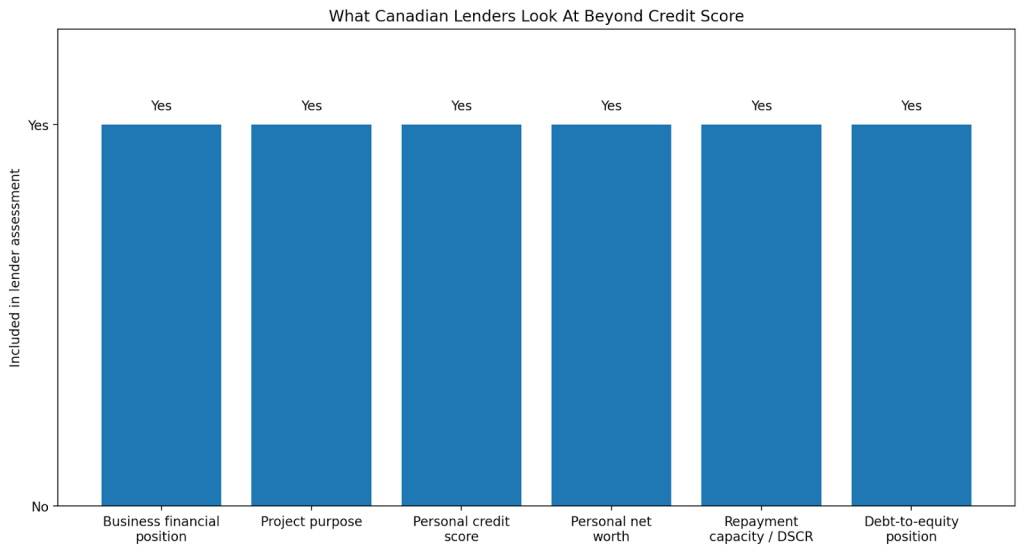
However, lenders rarely rely on credit score alone. They also evaluate:
- Business performance and revenue trends
- Financial position and leverage
- Owner’s net worth and involvement
- Purpose and structure of the loan
Key takeaway: A weak credit profile narrows options—but it does not automatically disqualify a business.
What Lenders Evaluate Beyond Credit Score
1. Cash Flow and Repayment Capacity
Lenders focus heavily on whether your business can support loan payments.
- Stable or growing revenue increases confidence
- Predictable cash flow reduces perceived risk
- Clear repayment plans strengthen approval
2. Debt Position and Financial Structure
Two core indicators often reviewed:
- Debt service coverage: Ability to cover loan payments from income
- Debt-to-equity: How leveraged the business already is
A business with strong revenue but excessive debt may still be declined.
3. Purpose of the Loan
Specific, well-defined uses are easier to approve than vague requests.
Examples of stronger cases:
- Equipment purchases
- Expansion with defined ROI
- Working capital tied to receivables or inventory
Required Financial and Tax Records
Strong documentation is often the deciding factor in borderline applications.
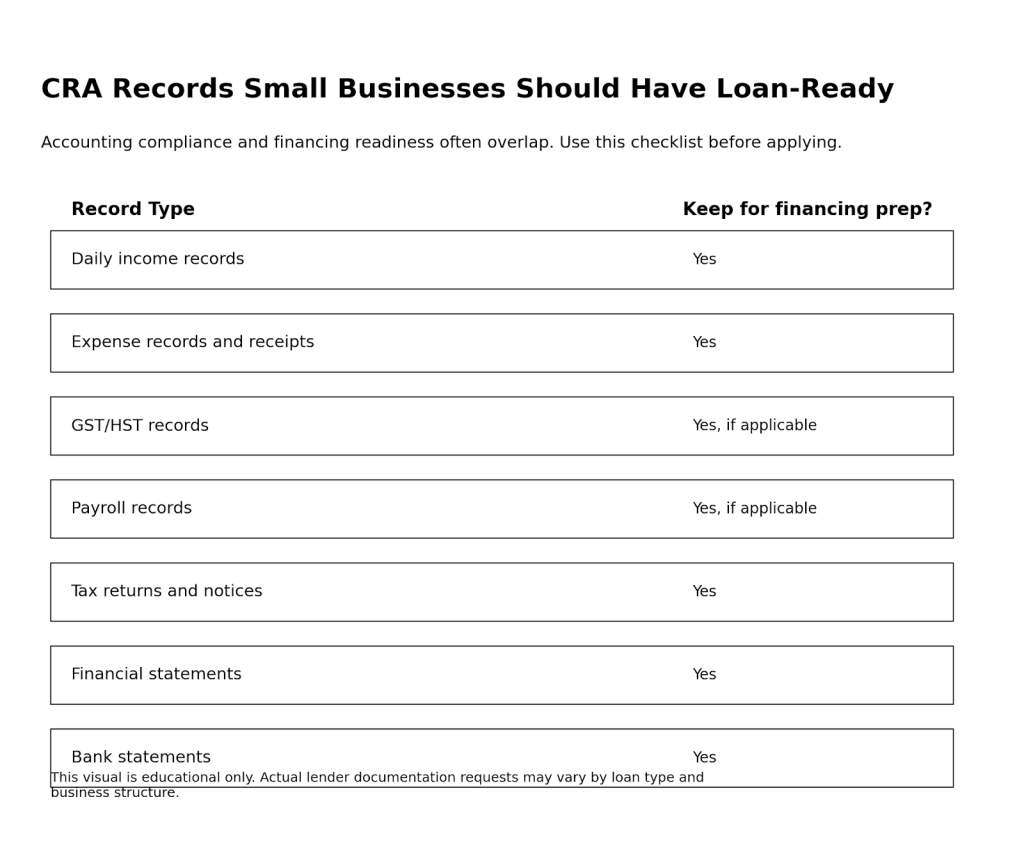
Businesses in Canada are expected to maintain complete financial records, including income, expenses, and supporting documents. Missing or inconsistent records can reduce lender confidence—even if the business is profitable.
Typical documents include:
- Recent financial statements
- Business bank statements
- Filed tax returns
- GST/HST filings (if applicable)
- Payroll summaries (if applicable)
- Accounts receivable and payable aging
- Business registration and ownership documents
- Clear explanation of how funds will be used
Insight: In many cases, improving bookkeeping has a greater impact on approval than improving credit score in the short term.
Financing Options for Bad Credit Borrowers
Business owners in Canada typically consider four main paths:
| Financing Option | Strength | Challenge | Best Fit |
| Traditional bank loan | Lower cost, stable terms | Stricter requirements | Established businesses with strong records |
| Government-backed programs | Risk-sharing improves access | Must meet program rules | Startups and small businesses |
| BDC-related financing | Designed for growth | Requires proof of viability | Businesses with clear expansion plans |
| Alternative lenders | Faster, more flexible | Higher cost | Urgent or non-traditional cases |
Decision insight: Speed, cost, and approval probability rarely align—choosing the right trade-off is critical.
Startups and Sole Proprietors: What Matters Most
Businesses with limited history must establish credibility quickly.
Focus areas:
- Filed and up-to-date tax returns
- Clean, organized bookkeeping
- Realistic financial projections
- Clear separation of personal and business finances
For sole proprietors, personal credit carries more weight, making accuracy and transparency even more important.
Step-by-Step: How to Improve Approval Odds
A stronger application starts before you contact a lender.
- Review your credit profile to identify errors or risks
- Update bookkeeping and reconcile accounts
- Prepare financial statements and cash flow forecasts
- Define a clear use of funds tied to business outcomes
- Match the lender to your situation (bank, program, or alternative)
- Compare total cost—not just speed of funding
Common Mistakes That Reduce Approval Chances
Even strong businesses get declined for preventable reasons:
- Applying with incomplete or outdated records
- Ignoring tax filing or compliance gaps
- Requesting funding without a defined purpose
- Prioritizing speed over affordability
- Failing to review credit reports beforehand
- Mixing personal and business finances
Pattern: Most rejections are driven by clarity and documentation—not just credit score.
FAQs
Can I get a business loan in Canada with bad credit?
Yes—if your business demonstrates strong cash flow, organized records, and a credible repayment plan. Approval depends on the lender and loan structure.
Do lenders prioritize credit score or cash flow?
Both matter, but cash flow and repayment capacity often carry greater weight in business lending decisions.
What documents should I prepare?
Financial statements, tax returns, bank statements, invoices, and any records that clearly show income, expenses, and obligations.
Are government-backed programs available to sole proprietors?
Yes, provided eligibility criteria are met.
How long should business records be kept?
Typically, records should be retained for six years after the relevant tax year.
Are alternative lenders easier to access?
They may be more accessible, especially for urgent needs, but often come with higher costs or stricter repayment terms.
Final Takeaway
A business loan with bad credit is not out of reach—but approval depends on whether your business can demonstrate reliability beyond the credit file.
In practice, lenders are asking one question: Can this business realistically repay the loan?
The strongest applications answer that clearly—with clean records, stable cash flow, and a defined purpose for the funds.
Speak With an Advisor
If you want to improve your approval odds, start with your financial foundation.
A Clearwealth accounting professional can help you:
- Prepare loan-ready financial statements
- Identify gaps in bookkeeping and tax records
- Structure a financing request that aligns with lender expectations
Request a tailored assessment to position your business for financing success.
Disclaimer
This article is for general educational purposes only and does not constitute legal, tax, or lending advice. Eligibility, rates, and approval criteria vary by lender and borrower profile.
Sources and References
Canada Small Business Financing Program
https://ised-isde.canada.ca/site/canada-small-business-financing-program/en
Canada Small Business Financing Program Guidelines
https://ised-isde.canada.ca/site/canada-small-business-financing-program/en/find-loan-your-small-business/canada-small-business-financing-program-guidelines
Frequently asked questions—For small businesses
https://ised-isde.canada.ca/site/canada-small-business-financing-program/en/frequently-asked-questions-small-businesses
Helping small businesses get loans
https://ised-isde.canada.ca/site/canada-small-business-financing-program/en/find-loan-your-small-business/helping-small-businesses-get-loans
BDC: How to get a business loan despite having a bad credit history
https://www.bdc.ca/en/articles-tools/money-finance/get-financing/find-financing-poor-credit
BDC: How a bank looks at your business
https://www.bdc.ca/en/articles-tools/money-finance/get-financing/how-a-bank-looks-at-your-business
BDC: What is the debt service coverage ratio (DSCR)?
https://www.bdc.ca/en/articles-tools/entrepreneur-toolkit/templates-business-guides/glossary/debt-service-coverage-ratio
BDC Financing
https://www.bdc.ca/en/financing
CRA: Business records
https://www.canada.ca/en/revenue-agency/services/tax/businesses/topics/sole-proprietorships-partnerships/business-records.html
CRA: Keeping records
https://www.canada.ca/en/revenue-agency/services/forms-publications/publications/rc188/keeping-records.html
CRA: GST/HST and payroll records
https://www.canada.ca/en/revenue-agency/services/tax/businesses/topics/keeping-records/gst-hst-payroll-records.html
Ontario: Get funding or more help
https://www.ontario.ca/page/business/start/get-funding-or-more-help
Innovation Canada Business Benefits Finder
https://innovation.canada.ca/innovation/s/list-liste?language=en_CA
RBC Business Loan Accelerator Program
https://www.rbcroyalbank.com/business/loans/business-accelerator-loan-program.html
TD Business Accelerator Loan Program
https://www.td.com/ca/en/business-banking/small-business/credit/business-accelerator-loan-program
CIBC Alternative Financing
https://www.cibc.com/en/business/advice-centre/starting-your-business/alternate-sources-of-financing.html
