

If you run a small business in Ontario, or you’re paid as a “contractor” worker classification can feel like paperwork you’ll deal with later. But CRA Canada doesn’t treat it that way.
When CRA reviews worker classification issues, it’s usually because payroll deductions, CPP, or EI were handled differently than they believe they should have been. That can lead to reassessments, interest, and stressful back-and-forth, sometimes years after the work was performed.
The tricky part? A contract that says “independent contractor” is not the final word.CRA Canada focuses on how the relationship actually works.
Quick Start: Pick Your Path
If You’re a Business Owner Paying Workers
☐ List everyone who provides services (including “freelancers”)
☐ For each person, assess control, tools, schedule, and risk
☐ Confirm payroll obligations CRA Canada expects if they’re employees
☐ Keep documentation that reflects reality—not just template contracts
☐ Consider requesting a CRA ruling if unclear
If You’re Paid as a Contractor
☐ Do you control how work is done—or just when you’re paid?
☐ Can you work for multiple clients?
☐ Do you carry real business risk?
☐ Do you understand CPP and EI implications?
☐ Consider requesting a ruling if status feels misaligned
If You Want the Cleanest Approach
☐ Conduct a classification review now
☐ Align contracts + workflow + payroll setup together
☐ Maintain an “audit-ready” file for each contractor role
Why CRA Canada Focuses on Worker Classification
Worker classification affects:
- Whether payroll deductions must be withheld
- Whether earnings are pensionable under CPP
- Whether employment is insurable under EI
- What tax slips are issued (e.g., T4 vs other reporting forms)
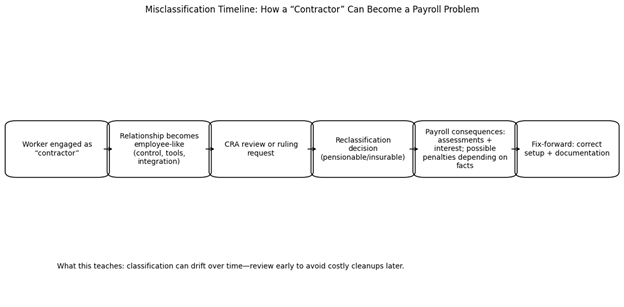
CRA Canada guidance explains that employment status determines how income tax, CPP, and EI rules apply. If CRA determines someone should have been treated as an employee, the payer may be assessed for amounts that should have been deducted and remitted—plus interest and possible penalties.
This is where misclassification becomes expensive.
Contractor vs Employee in Canada (Plain English Version)
Here’s the clean mental model:
- Employees work in a business.
- Independent contractors work with a business.
The distinction is not about remote work, flexible hours, or long-term relationships.
It’s about how the relationship functions day-to-day. CRA Canada applies a multi-factor approach, meaning no single factor decides the outcome. The full relationship is reviewed.
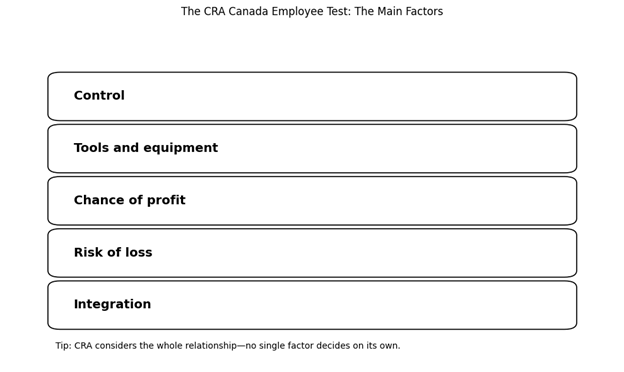
The CRA Canada “Employee Test”: What Actually Gets Reviewed
There is no single checklist. CRA evaluates the totality of the working relationship.
1. Control
Ask:
- Who decides how the work is done?
- Who sets hours and priorities?
- Is there supervision similar to staff oversight?
Greater control by the payer often points toward employment.
2. Tools and Equipment
Ask:
- Who provides essential tools (laptop, software, vehicle)?
- Who pays for maintenance and supplies?
Contractors often invest in and maintain their own tools.
3. Chance of Profit / Risk of Loss
Ask:
- Can the worker increase profit by working efficiently?
- Can they lose money if costs exceed expectations?
Employees typically do not carry business risk.
4. Integration
Ask:
- Is the worker integrated into core operations?
- Do clients view them as part of your team?
This factor often aligns with overall reality.
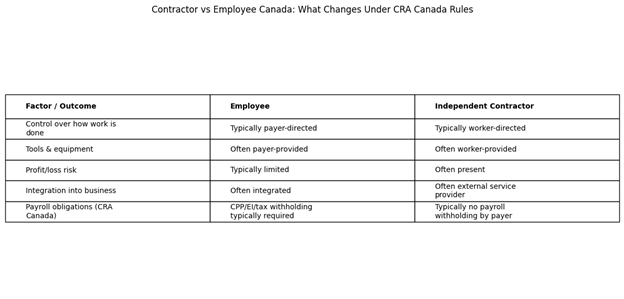
| Factor | More Likely Employee | More Likely Contractor |
| Control | Set hours, direct supervision | Sets own methods and schedule |
| Tools | Employer-provided | Worker-provided |
| Risk | No financial risk | Bears business risk |
| Integration | Embedded in operations | Independent service provider |
No single factor determines status. CRA Canada considers all of them together.
What Changes If Someone Is an Employee
If classified as an employee, CRA Canada generally expects:
- A payroll program account (if applicable)
- CPP and EI withholdings
- Income tax deductions at source
- Timely remittances
- Required year-end reporting
Failure to withhold and remit properly can lead to:
- Reassessments
- Interest on late amounts
- Potential penalties
Misclassification isn’t just administrative—it can directly affect cash flow.
CPP and EI Basics (Without the Jargon)
CPP (Canada Pension Plan)
Most employment income is pensionable. Employers deduct CPP contributions and match them.
Self-employed individuals generally handle CPP differently through personal filings.
EI (Employment Insurance)
Many employment roles are insurable, and premiums are processed through payroll.
Self-employed individuals typically do not participate automatically, though voluntary EI special benefits programs exist.
Classification determines which rules apply.
Step-by-Step Roadmap to Get Classification Right in 2026
1. Map Every Worker Role
List all service providers:
- Part-time help
- Freelancers
- Subcontractors
- Seasonal workers
- Long-term contractors
2. Document the Reality
For each role, record:
- Who controls work methods and timing
- Who supplies tools
- Payment structure (hourly, project-based, retainer)
- Ability to subcontract
- Whether they serve multiple clients
3. Align Contracts With Reality
A strong contractor agreement should reflect:
- Independence and autonomy
- Ability to work for others
- Clear invoicing terms
- Defined deliverables (not employee-style hours)
If the contract says “contractor” but daily operations resemble employment, risk increases.
4. Correct Payroll Setup If Needed
If a role is employment-like:
- Open or update payroll accounts
- Confirm remittance schedules
- Apply proper deductions
- Issue appropriate slips
5. Consider a CRA Ruling (Form CPT1)
If uncertainty remains, either party may request a ruling from CRA Canada. Note that time limits apply for requesting rulings.
Common Mistakes That Trigger CRA Problems
Believing the contract label controls everything
CRA reviews actual working conditions.
Paying hourly with fixed shifts but calling it “contract”
Structure can look like employment.
Long-term exclusivity without independence
One-client dependence can weaken contractor arguments.
No documentation trail
Keep:
- Signed agreements
- Invoices
- Proof of business registration (if applicable)
- Evidence of multiple clients
Waiting for a CRA letter before reviewing
Proactive review is less costly than reactive correction.
FAQ
Can CRA Canada reclassify a contractor as an employee?
Yes. CRA may issue rulings and reassess payroll-related amounts based on findings.
What are CRA Canada misclassification penalties?
Consequences may include assessments for unremitted deductions, interest, and potential penalties depending on circumstances.
Do independent contractors pay CPP and EI?
CPP treatment differs between employees and self-employed individuals. EI generally applies differently, though voluntary programs exist for self-employed individuals.
Can I request certainty from CRA?
Yes. A formal ruling can be requested using Form CPT1.
What if the relationship changed over time?
Classification should reflect current reality. Annual reviews are wise—especially when duties or payment structure changes.
Is this different in Ontario?
Worker classification for tax purposes is federal (CRA Canada), but Ontario employment standards and other provincial rules may also apply.
Calm Wrap-Up for 2026
CRA Canada worker classification rules do not demand perfection.
They demand consistency between:
- How the relationship operates
- What the contract says
- How payroll is handled
If you take one thing from this guide, let it be this:
Worker classification is not a label. It is a relationship you must be able to explain and support. If you’d like help reviewing your contracts, workflow, and payroll setup to create an audit-ready classification framework for 2026, speak with an Ontario accounting professional before CRA asks the questions.
